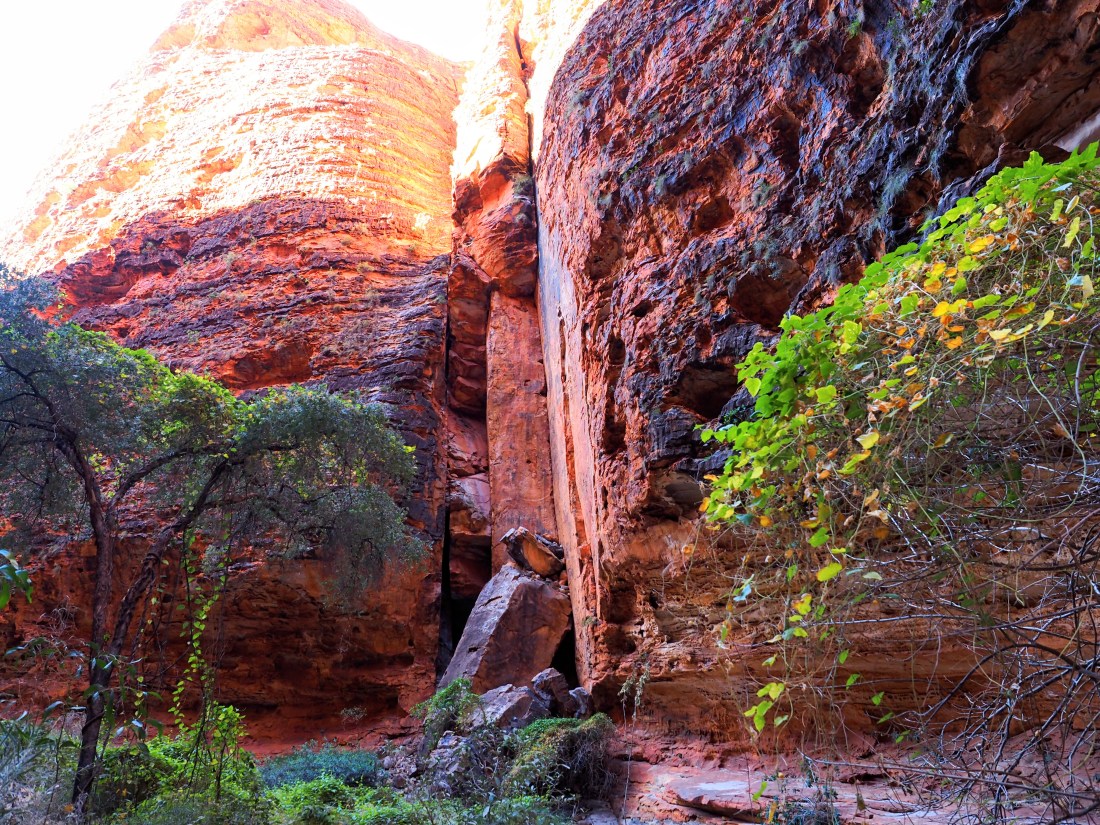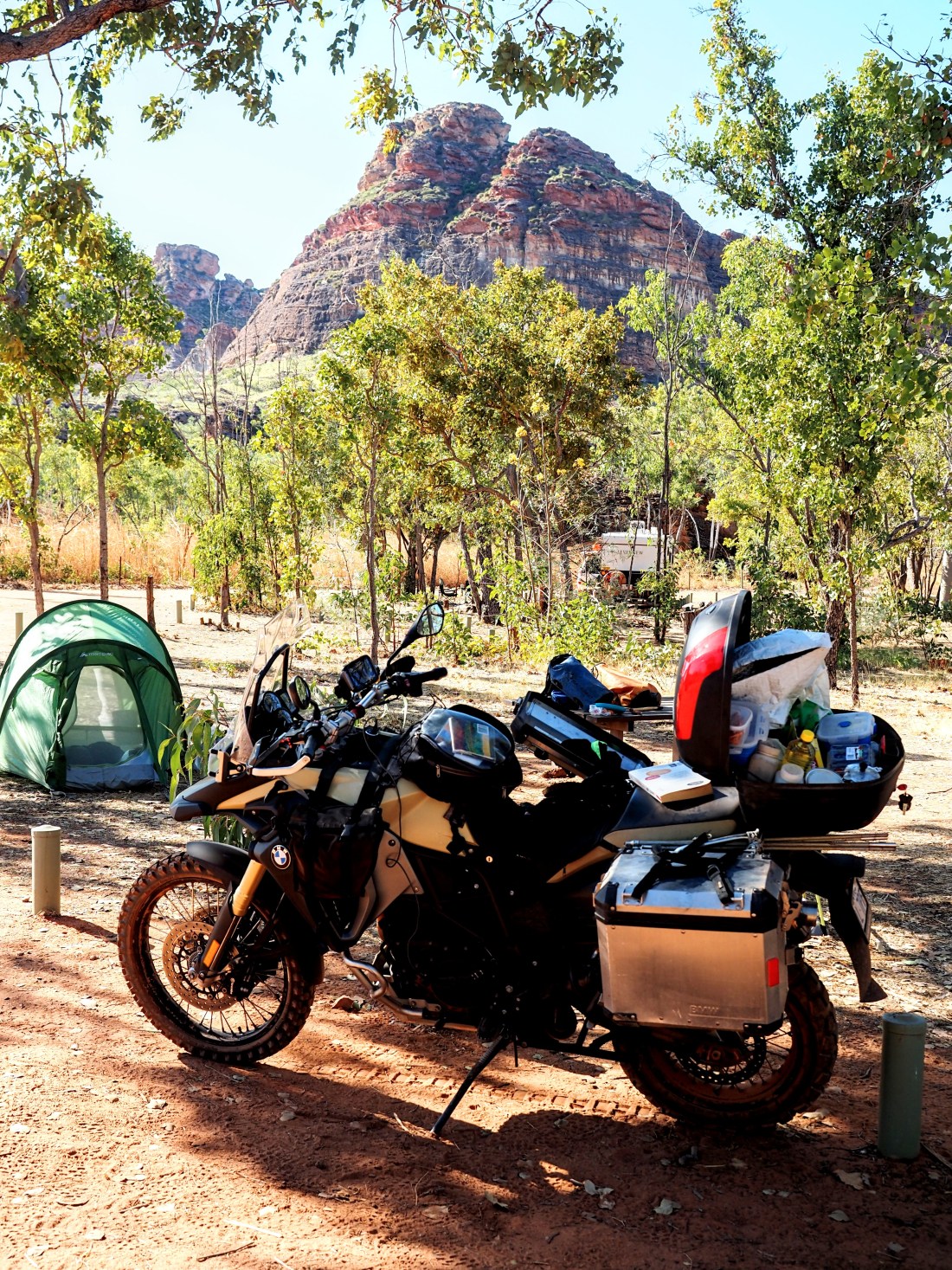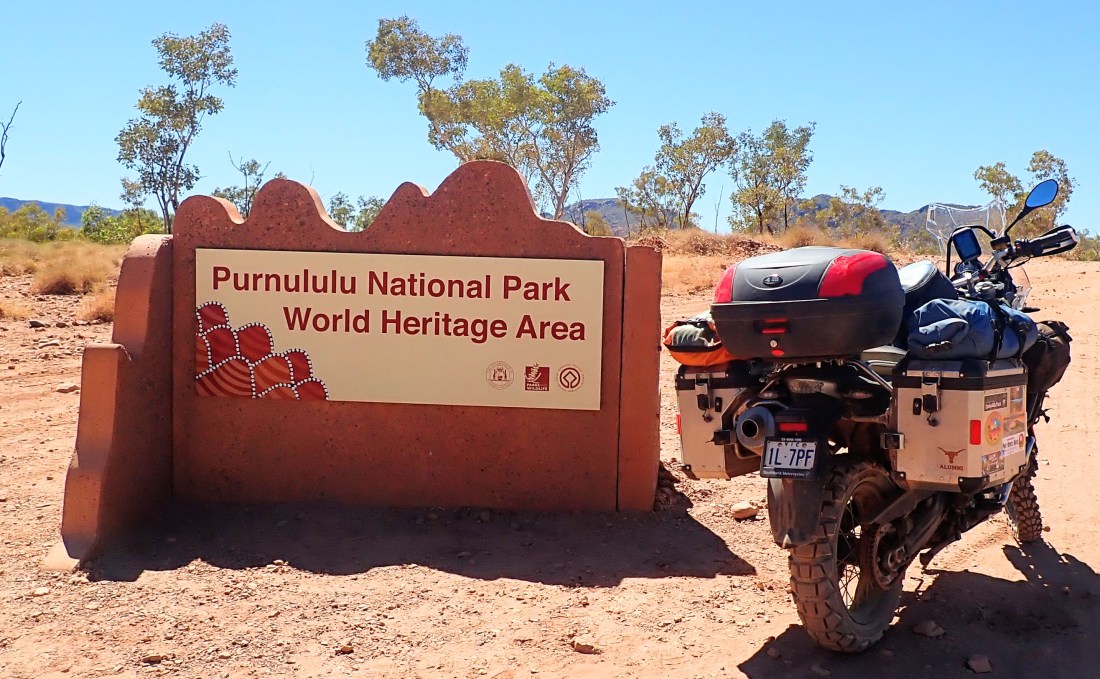
The World Heritage Purnalulu National Park aka the Bungle Bungles.

The Purnalulu National Park contains a number of unique rock formations one of which is the Bungle Bungle Ranges.

It’s 53 km from the Northern Highway into the Park and I have to say possibly the most challenging 53 km I have ridden this trip.

The road was extremely rough with 4 water crossings 2 quite deep.

As this 4wd came through the first water crossing (above) my heart started thumping as I thought this is a challenge.

At the third, and deepest crossing I thought I was beaten. I let a 4wd go through. The next thing it was stopped at the top of the embankment and the driver is down into the water.

“You can do it. I’m.a biker too. Keep to the left side there are less rocks”

“This is the deepest part” he said, standing thigh deep in water. “You can do it”

And I did as he talked me through the crossing.

I set up camp at the Kurrajong campground and the view of the Bungle Bungles at sunset told me the ride in was worth it. I was looking forward to riding out to the walking areas the next day.

The Bungle Bungles are unique rock formations formed around 300 million years ago.

The colours and contours of the landscape just breathtaking.

At the northern end there are huge gorges of red firey rock

The Northern walk (above) are is named Piccaninni after the creek that cuts through the land scape and is noted for its dome shaped rock formations and steep gorges. Cathedral and Whip Snake were the ones I visited.

The southern walks are characterised by amazing chasms. Echidna chasm is a thin passage through the 200 metre high cliffs.

The southern chasm entrances provide the perfect environment for the Livinstona Palm

Especially in the Palm Valley.

Purnalulu was a special way point on this trip and what an overwhelming beautiful place to visit.

I was even lucky enough to have a fellow biker for company.

Back heading west on the Savannah Way and a stop at Keep River National Park

The savannah woodlands stretched out to the horizon.

Crossing the big rivers I didn’t need a sign to say I was back on the Savannah Way.

Just before the Northern Territory/ Western Australia border there is the Keep River National Park.

About 18 km in from the Rangers station is the main camping ground.

A special part of North Western Australia is the amazing rock formations.

There are a number of walks through the rock canyons at Keep River. I will give you a taste of these beautiful rock formations.

From the lookout the rocky range stretches out through the savannah

The stunning colours of the rock and landscape.

And there is the beautiful Rainbow Bee Eater, flitting around the forest.

As the sun sets the rocks turn red reflecting the setting sun’s fire.

When the light is gone the Milky Way fills the sky.

There is nothing like the stars in the outback.

So I’m now sitting in Kununurra, in the State of Western Australia. Supplies have been purchased ready for the next outback leg of my journey.

Nitmiluk National Park 4 -some final observations

The Cutta Cutta caves limestone caves may not the most colourful but are an amazing insight to the forming of the artesian springs in the Northern Territory.

In the wet season this cave and others like it act as funnels collecting the monsoonal rains to flow through the limestone and into the artesian basin.

The water heats up and flows out at thermal springs at Mataranka and Katherine.

The sunset over the Katherine with the bats taking off into the night ( look closely at the photo just above)

The birdlife is abundant but at Edith Falls there was something special.

This Great Bower Bird singing his full repertoire of songs. (The Great Bower Birds are amazing at mimicking sounds which they include in the songs. Other birds calls, engines starting, towels fluttering are all included.)

His singing was successful as he seduced this female into his carefully constructed Bower.

How wondrous is nature.

Nitmiluk NP 3 – the Arnhem Land Plateau and Aboriginal Rock Art

There are significant sites of rock art all around the Nitmiluk NP.

There are sites in the public access areas of the Gorge

There are remote areas accessible only by helicopter

And special areas only accessible with aboriginal guides, in remote communities. Unfortunately due to Covid 19 access to remote aboriginal communities is not available.

The Arnhem Land Plateau is amongst the oldest exposed rock in the world.

Being formed 1,600 million years ago.

In the wet season the sandstone acts as a giant sponge soaking up the flooding waters that flow as springs and waterfalls in Nitmiluk and Kakadu in the dry season.

We landed at a spring atop the Arnhem Land Plateau

Around the spring were six galleries of aboriginal art

This was a place for dreaming hence the yellow Mimi spirit, catching fish, and giving birth.

I can’t capture the galleries painted thousands of years back are.

In the main Gorge the rock art is more accessible

For us, non aboriginal people this art are interesting images.

For aborigines they tell a story of how the land was formed and changed over tens of thousands of years

How to find food and water in the wilderness.

How to live as one with the land.

Nitmiluk National Park 2 – colours of Katherine Gorge

Katherine Gorge is the tourism centre piece of the Nitmiluk National Park.

The Gorge is over 16km long. In the dry season it is made up of 13 separate gorges each separated by natural rock rapids and waterfalls.

In the wet season, the monsoon, the water depth is, average 7 metres higher and the Gorge is one rushing torrent of water.

I was there in the dry season.

From a kayak there is a water eye view of the steep cliffs and the little barriers that separate the 13 sub gorges.

On an evening boat cruise at sunset the colours and the reflections take on a more reddish hew.

And after the sun has set

If your lucky the full moon rises

And of course there are the inhabitants of Katherine Gorge

The fresh water crocodiles

The colours of Katherine Gorge are indeed beautiful!