Dubrovnik was only about an hour from the Montenegro border on the return trip to Split after from Turkey. It was late September, and the high temperatures had moderated. Also there were a lot fewer tourists visiting.
Hence, it was a good time for this tourist to visit this famous city.
While the old city is the tourist focus of Dubrovnik, the new town is vibrant with lots of cafes and access to beaches.
Heading north along the coast toward Split in late September was a beautiful ride. In mid-August, an attempt to travel south from Split just led to gridlock and frustration.
There are beautiful views of the offshore islands and quaint villages and yacht harbours along the way.
One of the beautiful small towns is Omis. It’s only 25km south of Split and sitson the estuary of the Certina river.
Unfortunately, the skies opened (one of only a few wet days I had in 3 months of travel) at Omis, so exploring the town and its beaches was limited.
That put me back in Split, and as September was drawing to a close Iqas on the night, ferry back to Italy.
From the Gacka Valley, I headed south along the mountains to Lake Peruca, in the mountains east of Split.
The mountain road south runs parallel with the Bosnia and Herzegovina Border, and through the Dinaric Alps
This region hosts the Dinaric Rally, a major cross country motorcycle endurance event.
Lake Peruca is a man made lake and a major source of hydro electricity. It also has a number of camping sites and villages.
I chose Camping Peruca by the lake. The campsite had water access for swimming. From the campsite, it was a short ride into the Danaric Ranges and the headwaters of the Certina River that feeds the dam.
The ride to Split is a little over an hour, mostly winding through the Certina Valley.
Spit is Croatia’s second largest city. Its a great place to get any equipment, like misplaced gloves or gloves or repairs such as a new tyre. Its also a ferry hub. As I came into Split in mid August and left late September. While it was still pleasantly warm in September, there were nowhere near the crowds, so getting around the old and new city was a lot easier.
The old city was interesting with its mix of Roman and Greek architecture.
Out of the old city and main harbour the new city is colourful and where the best swimming beaches are.
As an old city, Split didn’t have the history or beauty of Ortigia (which I found entrancing). But it is well placed for visiting other Balkan countries and for accessing the many islands on the Croatian coast.
The overnight ferry from Anconna arrived in Split on a hot Croatian morning.
With very hot weather forcast for the Croation Coast, I decided to head to mountains of Northern Croatia, in particular the Gacka Valley.
The cleat water of the Gacko river flows through the valley.
The Gacko Valley sits between two natural attractions in Croatia; Plitvice Lakes National Park and the Samograd Cave.
The Plitvice Lakes are a spectacular series of lakes and waterfall.
Entry into the National Park is strictly ticketed, and given it was the peak holiday season, there were large crowds. I, therefore, took a walk around a forest trail that overlooks the Lakes. As you can see, it gives good views of the lakes and puts you at the top of some on the waterfalls.
The Samograd Cave goes deep into the limestome mountains, and the 8c temperature inside the cave quite a contrast to the 35c+ temperatures on a hot mid August day.
Access to the cave is ticketed and is underaken in small groups with a guide.
The motorcycle riding through these mountains is beautiful.
On a hot summer, the mountains are about 4c less than on the coast. For me that meant low to mid 30s and opposed to high 30s.
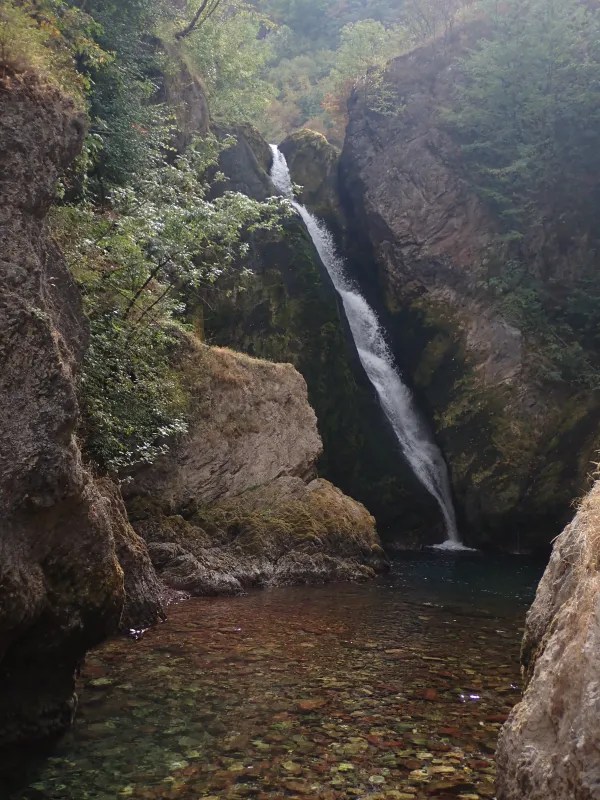
But don’t worry, you can still find a place to swim if you get local advice. I was given directions to this lovely swimming hole between Gacka and the Plitvice Lakes.
After arriving in Croatia I travelled north to the beautiful Gacka Valley with the aim of staying a few days in his beautiful part of the country.
I booked a room in the small village of Zalznica and looked forward to exploring the area.
Dinner that night was at Bistro JELEN, where I became a regular.
I asked the chef, Zeljko, about hiking in the area. He warned me to stay to the trails as may still be land mines in the forest. This was my first encounter with the scars of the Balkans civil war, that raged from 1991 to 1999 and in some places like the Serbia/Kosovo border still happening.
In Mostar, the scars are still visible on the streets where brutal fighting in close quarters took place.
The scars are also visible in the small cemetaries that are dotted through the countryside. I couldn’t bring myself to photograph any. As one photo could not represent the large number of these new cemetaries or the death contained there.
At Blagaj, near Mostar, there is a Sufi Mosque that sits above one on the largest springs in Europe.
This cushion sits in the little reading room of the most. A memorial to the Massacre at Srebrenica.
Travelling through the Balkan Countries. Monuments to.war are a regular occurrence.
In 2019, I visited Ljubjana, where there is a monument to the Peasant Uprisings. A moving monument that remembers the slavic peoples revolts against the Austro/Hungarian Empire.
ANZAC COVE, holds a special place in Australian history and mythology. Being so close to Gallipoli, where the Cove is located, I decided to visit. What’s another 1000km or so anyway.
I have always wondered why the Gallipoli campaign is so important. Australian forces took part in an attempt to invade Turkey. Turkey had only recently joined WW1 on the side of Germany.
The attack was a total failure with enormous casualties on both sides.
There are monuments to the dead on both sides.
It was said that WW1 was the war to end all wars.
In Australia, on ANZAC Day and Armistice Day, we all say Lest We Forget. But we do forget as the war ploughs headlong into more wars, more suffering, more death.
A few weeks after travelling through Kosovo, there was a fire fight near the Serbian/Kosovo border, killing 8 people. I had been near there.
Dear friends and followers, I’ve struggled with the ever-present reminders of war I encountered in the Balkans. Hence, this blog.
Normal broadcasting of lighthearted travel and adventure stories can now resume.
It’s been a long time since I have written and many thousands of kilometres have been covered in that time.
Back home now in Australia, spring has sprung and its time catch up on tales my latest European Adventure before I commence this summers adventures.
But before I go into reflection a little local update.
Since arriving home I’ve bought a new motorbike, a beautiful Moto Guźzi v85tt.
Taking it to do a bit of show and tell at the Spaghetti Rally, a fantastic rally run by the Moto Guzzi Club of Victoia.
I’ll give a give a bit of a snapshot of where I went in Europe this year. Before doing more detailed posts on the destinations.
First, there was Sicily,
OrtigoaMt Etna
Then …
Puglia,
Rome
San Marino
Croatia
Dubrovnik Plitvice
Bosnia-Herzegovina
Mostar
Montenegro
Albania
Greece
Turkey
North Macedonia
Kosovo
White Din waterfall
France
St Malo
England
I spent longer in some countries than others and especially in Greece and Turkey, only touched these large and diverse countries. But all this will be explained in future blogs.
For now, it is good to be home with family and friends. Its spring time and in my favourite places the wading birds are arriving nesting mating and having babies.