The Darling River and Lake Mungo

The Murray and Darling rivers converge at Wentworth. These rivers form the Murray – Darling Basin which is an area important for both food production and environmental diversity.

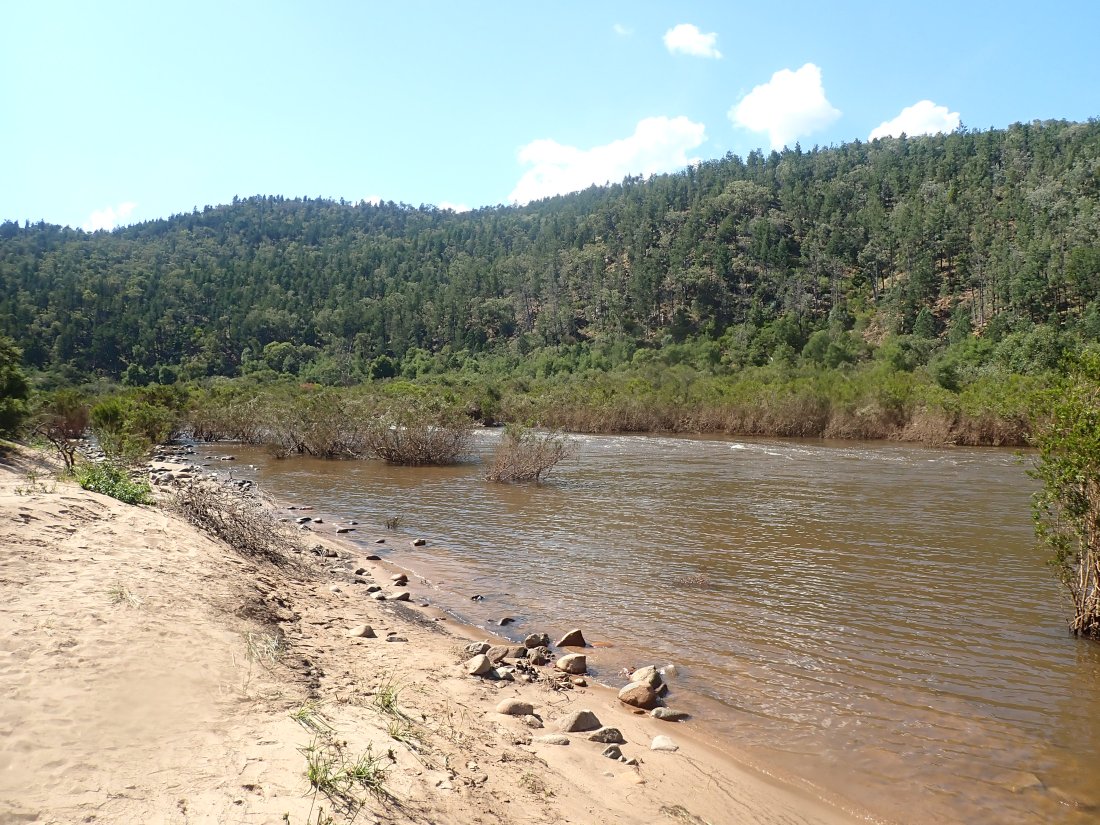
The Murray starts in the Australian Alps near Mount Kosciusko fed by snow melt and Alpine rain. The Darling is fed by the monsoons of northern Australia. In the photo you can see the muddy water of the Darling in the foreground as it mergers into blue water of the Murray.

I camped 20km down stream of the rivers junction on the banks of the Murray.

Beside the Murray River as it slowly rolls south west to the Southern Ocean around 500km away.

In many ways the Murray forms the southern boundary of the Outback or at least the southern east corner of the hot dry lands that are the outback.

I had ridden up from a cultural holiday in Adelaide and this was the first stop on the edge of the outback that would lead me to Mungo National Park (my next stop) then up the Darling to Bourke (previous post).

Leaving the banks of the Murray it was onto the dirt roads to get out to Mungo National Park – A World Heritage area.

It was hot and I was happy to set up my tent under a shady tree

The Park was once sheep station and the old shearing shed a relic of those times.

Mungo National Park has both colonial and aboriginal history. The colonial history goes back a century or so. The aboriginal history is an over 46,000 years continual association with the land.

This long association was confirmed with the finding of the remains Mungo Man and Mungo Lady. These remains that have been dated as 46,000 years old. These are the oldest homosapian remains found on the Australian Continent. These are also some of the oldest examples of ritualistic burial any where in the world. If you want more information follow this link: https://learn.culturalinfusion.org.au/story-of-mungo-man-and-mungo-lady/

Another feature of Lake Mungo is the sand dunes that stretch for 135km across the horizon like the walls of China, but nature made.

Areas of dunes are called Lunettes because of the luna type landscape. But in these dunes are artefacts tens of thousands of years old.

At sunset the dunes tale on a redish hue as the sun burns the sky orange and red.

That night I slept with wonderment of the place and what a tiny spec modern humanity is on the universe while sleeping under the milky way.

In the morning I did a tour of the dunes with an aboriginal ranger. As part of the tour I help artefacts 10,000 years old and heard stories of the land, this place that had been passed down from generation to generation in the oldest continuous culture in the world. Stories and rituals that had their origin back 46,000 years ago.

As I left Lake Mungo there was a Sand Goanna on the side of the road.

I thought it was wishing me a fond farewell but, looking back, I think that it was a sign that the 350+km of dirt road I had before me to get to Bourke was going to be a difficult and sandy ride.

Been out Back o’ Bourke

In other words the outback,

Out past where the Darling River flows.

Where the roads are rough dirt and sand

The land is harsh and hot

That’s 45c hot on an early autumn day and the days in 38 – 45c range stretched on while I was there.

The recent floods meant that the inland rivers were flowing.
And in Wilcannia where the banks are 12 metres above the normal river height

But the high water line on the doors of the shower cubicals shows the flood got well over 12 metres.

The locals told me that in Bourke when the water was at its highest it was running over the old wooden lift bridge. A relic from the days when paddle steamers plied Australia’s inland rivers.

Water is life. Not just for humans, but for animals, especially birds.

The kites circling in the skies over the rivers.

The waterbirds in the river.

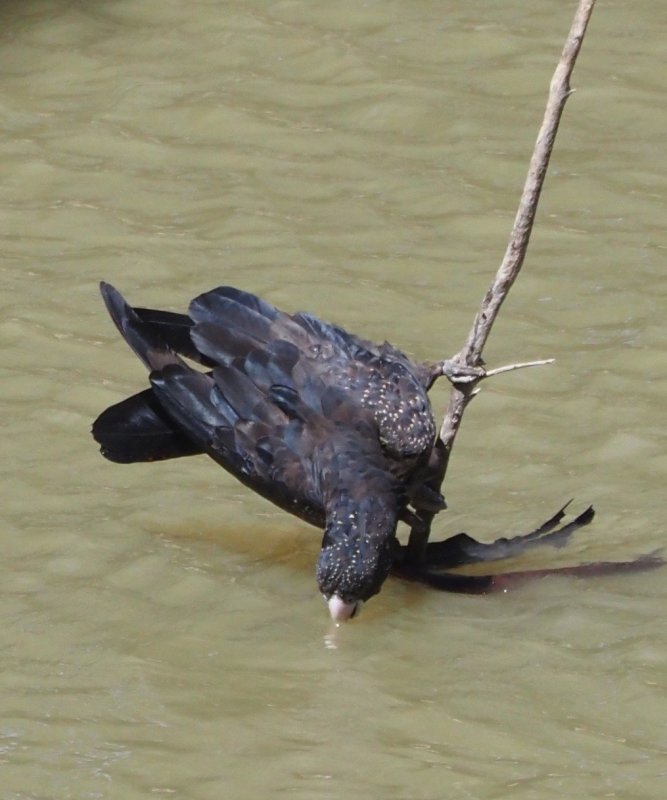
My favourite was the raucous Glossy Black Cockatoos that came down to the river to drink.

While there is always beauty there are also constant reminders of the harshness of the Outback.

There is also something quirky outback and for me this time it was an amazing stick insect.

There is also something quirky outback and for me this time it was an amazing stick insect.

The dry, dusty, sandy, and rutted roads

The dry red soil

The millions of fish that die when the relentless heat suck all the oxygen out of the water.

The dead Dingo hung in the tree. Supposedly to scare off other Dingos, but more likely a reassurance to the shooter that he has control of the environment. There is no controlling this wild country.

Not far on from.the Dingo Tree is Warnaaring -200kn out Back o’ Bourke. I stayed at the camp ground.

The owner just laughed when I said I was looking forward to a cool shower.

I turned what I thought was the cold tap. Scalding water came spurting out. I quickly turned the tap off. I turned on the other tap and heard the gas hot water heater burst into life as piping hot water came forth.- tap off. Back to my first choice of tap and let it run a bit.

Agh after a little while a nice hot shower from the cold water tap. I guess that’s how hot the sandy soil gets after long spells of 40c heat.0

There is always something quirky about the outback, everytime I visit. This time it was amazing stick insect

You have to look so closely to distinguish it from the tree twigs!

Each trip to the outback is a learning experience.

The Sub- Tropical Mountain Gondwana Land Rain Forests On the Great Dividing Range of Australia. -1

I take a few backroads avoiding the main highways and the traffic. Especially the big trucks. Ah the aptly named Black Stump Way.

Coolah is a small town a bit over half way on the trip and the hotel a good place for a night stopover.

The painted silos at Barabba are worth a stop on the Fossickers Way that leads up into Queensland.

The King and Queen Parrot giving me a welcome to Queensland.

Tambourine Mountain sits just west of the Gold Coast. Its a pleasant tourist destination and Queensland’s first National Park. Established in 1905.

A beautiful place to walk in some gondwana rain forest.

As well.as the parrots the kookaburras were a plenty.

And as the night fell the lights of the Gold Coast twinkled in the distance.

Definitely a very different place and seemingly a world away. 


The mountains and the sea of South East Australia. Part 2 – water flowing to sea

Rivers are like arteries of the land

The water they carry the life blood

Water is life!

Something we should never forget.

The Murray River, the longest river has its head waters in the mountains of South East Australia and wends a long path west before crossing through three states to meet the sea.

But these mountains don’t take their from the Murray but share a name called Snowy.

The Snowy Mountains and the Snowy River are both known for their wild beauty

The Snowy River originates on Mount Kosciuszko and flows 352km to the sea at the 90 mile beach at Marlo.

The Snowy was a wild river now somewhat tamed by being dammed at Lake Jindabyne.

When I was younger I walked the trail to the peak of Mount Kosciuszko from the ski resort town of Thredbo.

This trip was a ride through the mountains south to follow the river from Lake Jindabyne to the sea,

The route was through the southern sections of the Kosciuszko National Park and into the Snowy River National Park camping at the famous McKillops Bridge.

The campground sits just above the river with a little beach on the Snowy River

McKillops Bridge is a long narrow wooden bridge opened in 1935 that spans a low gorge of the Snowy River and links remote villages in the mountains of South Eastern Australia.

Originally McKillops Bridge was to open in January 1934 but a huge flood sent a 14 metre high wall of water down the Snowy River lifting the wooden top structure off the concrete pylons. The rebuilt bridge was designed to withstand a 17 metre flood. Not that that is likely now the wild river has been tamed by Lake Jindabyne.

The Snowy River National Park is home to smaller rivers, tributaries and deep gorges in the mountains, reflectiong the wild remoteness of these mountains.

At the little village of Marlo the Snowy meets the sea

At Corringle Beach on the Marlo Estuary sits an old slipway where the boats that used to ply the old wild Snowy were pulled up for repairs.

An immature Osprey standing guard over the estuary

A small line of sind dunes separates the estuary

from the 90 mile beach and the wild sea that pounds it.

The Snowy drops from around 2000 metres high in its short 350kilometre journey to the Ocean. No wonder it was a wild river.