Croatia 2 – Split and the Central Mountains

From the Gacka Valley, I headed south along the mountains to Lake Peruca, in the mountains east of Split.

The mountain road south runs parallel with the Bosnia and Herzegovina Border, and through the Dinaric Alps

This region hosts the Dinaric Rally, a major cross country motorcycle endurance event.

Lake Peruca is a man made lake and a major source of hydro electricity. It also has a number of camping sites and villages.

I chose Camping Peruca by the lake. The campsite had water access for swimming. From the campsite, it was a short ride into the Danaric Ranges and the headwaters of the Certina River that feeds the dam.

The ride to Split is a little over an hour, mostly winding through the Certina Valley.

Spit is Croatia’s second largest city. Its a great place to get any equipment, like misplaced gloves or gloves or repairs such as a new tyre. Its also a ferry hub. As I came into Split in mid August and left late September. While it was still pleasantly warm in September, there were nowhere near the crowds, so getting around the old and new city was a lot easier.

The old city was interesting with its mix of Roman and Greek architecture.

Out of the old city and main harbour the new city is colourful and where the best swimming beaches are.

As an old city, Split didn’t have the history or beauty of Ortigia (which I found entrancing). But it is well placed for visiting other Balkan countries and for accessing the many islands on the Croatian coast.

Dorgali to Santa Maria Navarrese on the west of Sardinia.

Dorgali is a sprawling city in mountains on the west coast of Sardinia.

It has some beautiful street art and if you are prepared to walk up some steep steps wonderful views to be had.

But it’s the road south through the mountains on the western side of Sardinia that is the real reason for going to Dorgali.

This road is in perfect condition and the views sublime!

https://videos.files.wordpress.com/RDpZ7MBh/20230727_120749.mp4

Santa Maria Navesse is a beautiful coastal village. There are a number of good quality camping grounds right on the clean beach.

Just a beautiful place to end an amazing ride.

For those considering the ferry from Cagliari to Palermo then it’s a nice ride to catch the evening overnight ferry.

The quiet of Santa Maria Navesse was in total contrast to the absolute chaos of the Grimaldi Lines ferry to Sicily. But that’s a story for another blog!

Corsica (La Corse) -1

As the ferry approached Bastia the clouds hanging low over the mountains was a portend of the hot and steamy welcome awaiting in Bastia.

The ferry berthed at 0700 and the line of exiting traffic snaked along the roads out of the city.

The road over the Col de Vergio (the highest road in Corsica) is one of the great rides of Europe. Therefore on my agenda.

Morning coffee at at a little village Cafe in the foothills was the perfect first stop of the day.

The road crosses Corsica from east coast to west finishing in the seaside village or Porto.

The eastern side of the Col climbs up though beautiful pine forests offering cool shade.

Higher the forests give way to rocky gorges, steep sloops and narrow ancient roads.

Till the Col is reached.

With the Virgin standing atop the Col

The road down to Porto on the west side of Corsica is also a cracker.

Don’t you just love those stone Corsican safety barriers.

The road, one of the great rides of Europe end ar the beach at Porto, a small boating village. The municipal camping ground is only 400 metres from the beach and offers cheap, shady camping sites.

And a cold beer at the beach bar after a long day’s ride and a swim.

The Darling River and Lake Mungo

The Murray and Darling rivers converge at Wentworth. These rivers form the Murray – Darling Basin which is an area important for both food production and environmental diversity.

The Murray starts in the Australian Alps near Mount Kosciusko fed by snow melt and Alpine rain. The Darling is fed by the monsoons of northern Australia. In the photo you can see the muddy water of the Darling in the foreground as it mergers into blue water of the Murray.

I camped 20km down stream of the rivers junction on the banks of the Murray.

Beside the Murray River as it slowly rolls south west to the Southern Ocean around 500km away.

In many ways the Murray forms the southern boundary of the Outback or at least the southern east corner of the hot dry lands that are the outback.

I had ridden up from a cultural holiday in Adelaide and this was the first stop on the edge of the outback that would lead me to Mungo National Park (my next stop) then up the Darling to Bourke (previous post).

Leaving the banks of the Murray it was onto the dirt roads to get out to Mungo National Park – A World Heritage area.

It was hot and I was happy to set up my tent under a shady tree

The Park was once sheep station and the old shearing shed a relic of those times.

Mungo National Park has both colonial and aboriginal history. The colonial history goes back a century or so. The aboriginal history is an over 46,000 years continual association with the land.

This long association was confirmed with the finding of the remains Mungo Man and Mungo Lady. These remains that have been dated as 46,000 years old. These are the oldest homosapian remains found on the Australian Continent. These are also some of the oldest examples of ritualistic burial any where in the world. If you want more information follow this link: https://learn.culturalinfusion.org.au/story-of-mungo-man-and-mungo-lady/

Another feature of Lake Mungo is the sand dunes that stretch for 135km across the horizon like the walls of China, but nature made.

Areas of dunes are called Lunettes because of the luna type landscape. But in these dunes are artefacts tens of thousands of years old.

At sunset the dunes tale on a redish hue as the sun burns the sky orange and red.

That night I slept with wonderment of the place and what a tiny spec modern humanity is on the universe while sleeping under the milky way.

In the morning I did a tour of the dunes with an aboriginal ranger. As part of the tour I help artefacts 10,000 years old and heard stories of the land, this place that had been passed down from generation to generation in the oldest continuous culture in the world. Stories and rituals that had their origin back 46,000 years ago.

As I left Lake Mungo there was a Sand Goanna on the side of the road.

I thought it was wishing me a fond farewell but, looking back, I think that it was a sign that the 350+km of dirt road I had before me to get to Bourke was going to be a difficult and sandy ride.

Been out Back o’ Bourke

In other words the outback,

Out past where the Darling River flows.

Where the roads are rough dirt and sand

The land is harsh and hot

That’s 45c hot on an early autumn day and the days in 38 – 45c range stretched on while I was there.

The recent floods meant that the inland rivers were flowing.

And in Wilcannia where the banks are 12 metres above the normal river height

But the high water line on the doors of the shower cubicals shows the flood got well over 12 metres.

The locals told me that in Bourke when the water was at its highest it was running over the old wooden lift bridge. A relic from the days when paddle steamers plied Australia’s inland rivers.

Water is life. Not just for humans, but for animals, especially birds.

The kites circling in the skies over the rivers.

The waterbirds in the river.

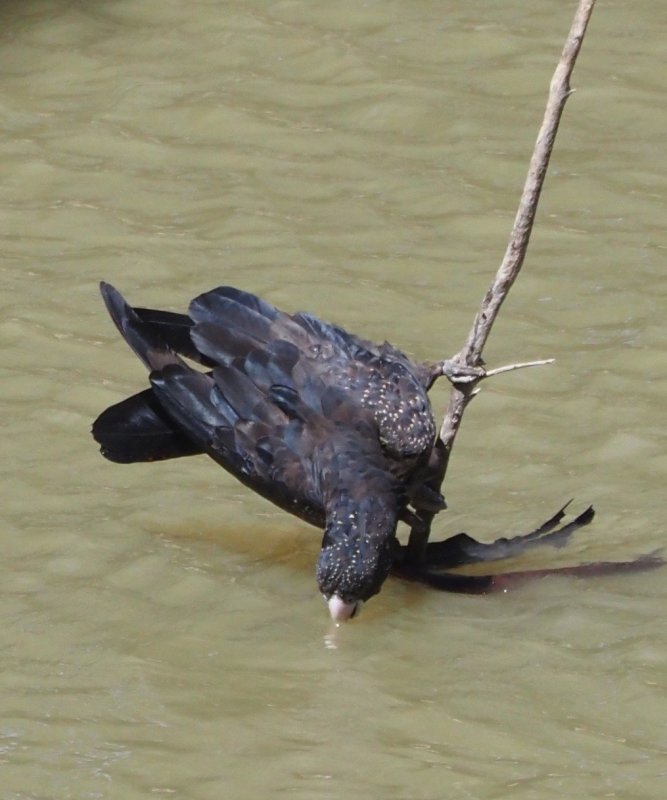
My favourite was the raucous Glossy Black Cockatoos that came down to the river to drink.

While there is always beauty there are also constant reminders of the harshness of the Outback.

There is also something quirky outback and for me this time it was an amazing stick insect.

There is also something quirky outback and for me this time it was an amazing stick insect.

The dry, dusty, sandy, and rutted roads

The dry red soil

The millions of fish that die when the relentless heat suck all the oxygen out of the water.

The dead Dingo hung in the tree. Supposedly to scare off other Dingos, but more likely a reassurance to the shooter that he has control of the environment. There is no controlling this wild country.

Not far on from.the Dingo Tree is Warnaaring -200kn out Back o’ Bourke. I stayed at the camp ground.

The owner just laughed when I said I was looking forward to a cool shower.

I turned what I thought was the cold tap. Scalding water came spurting out. I quickly turned the tap off. I turned on the other tap and heard the gas hot water heater burst into life as piping hot water came forth.- tap off. Back to my first choice of tap and let it run a bit.

Agh after a little while a nice hot shower from the cold water tap. I guess that’s how hot the sandy soil gets after long spells of 40c heat.0

There is always something quirky about the outback, everytime I visit. This time it was amazing stick insect

You have to look so closely to distinguish it from the tree twigs!

Each trip to the outback is a learning experience.