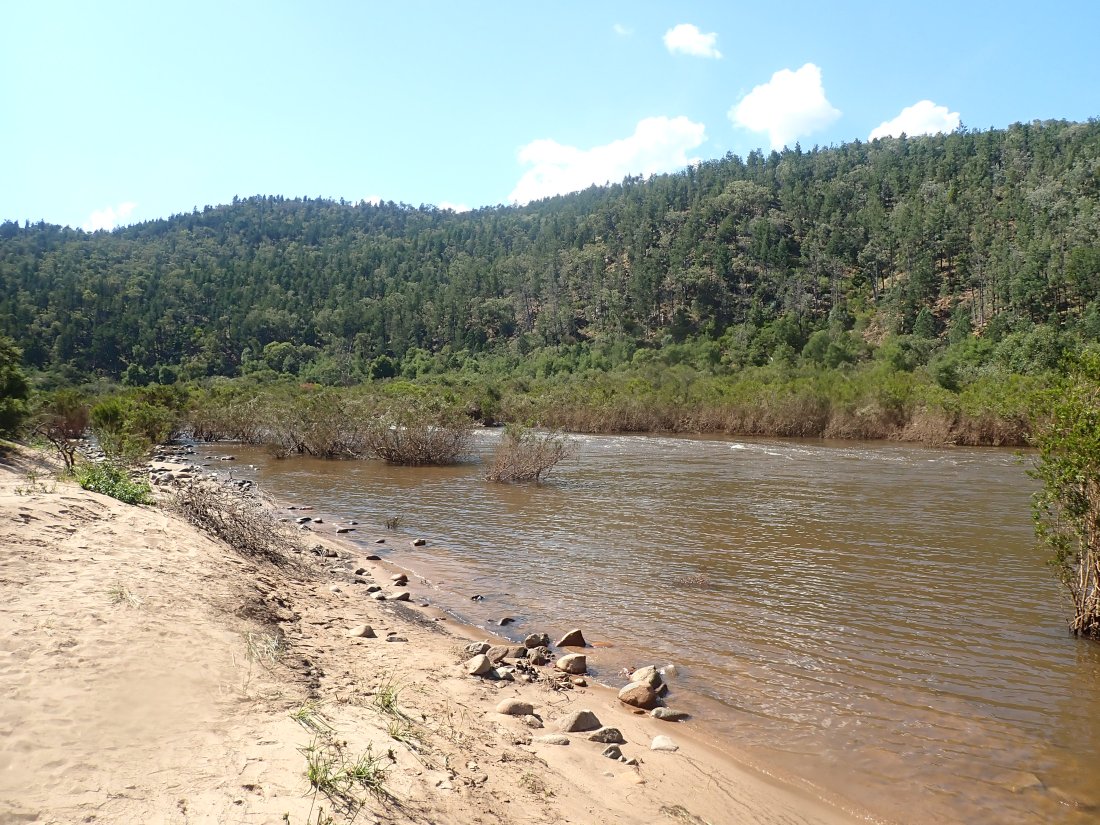
The Murray River, the longest river has its head waters in the mountains of South East Australia and wends a long path west before crossing through three states to meet the sea.
But these mountains don’t take their from the Murray but share a name called Snowy.
The Snowy Mountains and the Snowy River are both known for their wild beauty
The Snowy River originates on Mount Kosciuszko and flows 352km to the sea at the 90 mile beach at Marlo.
The Snowy was a wild river now somewhat tamed by being dammed at Lake Jindabyne.
When I was younger I walked the trail to the peak of Mount Kosciuszko from the ski resort town of Thredbo.
This trip was a ride through the mountains south to follow the river from Lake Jindabyne to the sea,
The route was through the southern sections of the Kosciuszko National Park and into the Snowy River National Park camping at the famous McKillops Bridge.
The campground sits just above the river with a little beach on the Snowy River
McKillops Bridge is a long narrow wooden bridge opened in 1935 that spans a low gorge of the Snowy River and links remote villages in the mountains of South Eastern Australia.
Originally McKillops Bridge was to open in January 1934 but a huge flood sent a 14 metre high wall of water down the Snowy River lifting the wooden top structure off the concrete pylons. The rebuilt bridge was designed to withstand a 17 metre flood. Not that that is likely now the wild river has been tamed by Lake Jindabyne.
The Snowy River National Park is home to smaller rivers, tributaries and deep gorges in the mountains, reflectiong the wild remoteness of these mountains.
At the little village of Marlo the Snowy meets the sea
At Corringle Beach on the Marlo Estuary sits an old slipway where the boats that used to ply the old wild Snowy were pulled up for repairs.
An immature Osprey standing guard over the estuary
A small line of sind dunes separates the estuary
from the 90 mile beach and the wild sea that pounds it.
The Snowy drops from around 2000 metres high in its short 350kilometre journey to the Ocean. No wonder it was a wild river.
In the rain forests and on the windy roads and trails in the Otway Ranges
I think my late life crisis hit its peak on my last trip to the Otway Ranges
Riding some of the more difficult trails, getting bogged in mud and in sand and having to muscle a big heavy bike out of those predicament
One beauty of the Otway Ranges is the waterfalls such as Beauchamp Falls
It’s also where the rainforest meets the Southern Ocean
But I think what I have missed most being back in a big city is the stars.
The lume of artificial light from a major city like Melbourne robs the night sky of its sparkling grandeur
But camped in the higher parts of the Otways on a clear crisp night with little but a camp fire to compete with the night sky put on a special show.
It’s 2022 now and we are entering the third year of the pandemic and for us in Australia the possibility of travelling overseas again.
I still have a bike in the UK and there is a strong urge to complete the journey to Morocco that I started in 2020 and that was bought to a sudden and abrupt halt in Spain and its first pandemic lock down.
Also there is nothing like riding a motorcycle in the Alps lol
Looking across to Grimsel Pass from Furka Pass in the Swiss Alps
Ps an addition for my friends in the US. In the Otways there is a small stand of Sequoia. They were planted in 1939, only babies in the life of these trees but already they are reaching high into the sky. A little bit of California in Victoria.
Friends and followers its a while since I last posted. At that time I foreshadowed further tales of my forebears pioneering times in Western Australia
But the truth is that 8 months of travel on a motorbike much of it sleeping in a tent left me tired and a case of still itchy feet complicated my enthusiasm to write
The only remedy was getting back out into nature.
To the east of Melbourne the Grand Ridge Road is a winding 132 km ride across the the Strzelecki Ranges and a mix of sealed and unsealed road.
The road runs through rich farming land, old growth temperate rain forest and sadly, old forests that have been destroyed by clear felling.
Coming down of the mountains the forest is dryer and the wild flowers abound.
To the West of Melbourne is the Great Ocean Road and the Otway Ranges – a favourite haunt I have written of often.
But even on a day trip to a well known area there are new places to find and the waterfalls were at their best after the spring rains
The swimming hole at She oak falls was too inviting to resist
Unfortunately I got to Stevenson Falls late in the day and as it was too late for a dip on a day trip
But I had been enjoyed my time having a beer and a swim at Wye River.
A stop off at the beautiful harbour at the coastal village of Apollo Bay
The perfect end to any day trip is of course- A beautiful sunset.
Now I’ve had a little interlude, a couple of day trips and the batteries are starting to feel recharged I will get back to my families pioneering tale. After you are warned at the start of my blog it is a discontinuous narrative!!!
The area around Fremantle and upstream in the Swan River to Perth is quite beautiful.
Beautiful sandy beaches flank the mouth of the Swan River and its bustling Port.
From Kings Park there are views over the River and the City of Perth
Kings Park includes the Perth Botanic Gardens and its amazing native flora collection.
Not that my Great grandfather would have had time to enjoy any of these beautiful sights as his home was Fremantle Gaol. From his arrival in 1853 until he and his brother were given a pardon in 1855 they worked, like all convicts on the gaol. The limestone extracted from the site of the gaol and cut into blocks on site.
It would have been hot dusty work with no escape. Summer temperatures in Perth are often in the high 30c range and not unusually 40c+. Temperatures unheard of in Ireland, but the convicts toiled in the heat, sleeping in quarters on the quarry at night.
I should introduce my Great grand father. His name was Edmund and his convict records describe him and 6ft and 1/2 inch tall (only 1 inch shorter than me) stout with a ruddy complexion, (mmm could be me) with brown hair and hazel eyes (phew Im not a reincarnation my hair was once ginger and eyes are blue). A tall strong man in modern days in 1853 he was the tallest on the ship and I can imagine that strength was well put to work in the prison quarry till he and his brother were pardoned in 1855.
Not long after being pardoned, Edmund married and Irish Bridget and with his brother they all headed west to the farming centre of York. York was the first inland white settlement in Western Australia with the colonial settlement process continued the dispossession of Aborigines starting in 1831.
So I followed in their footsteps and checked out of Fremantle Gaol and headed to York
Its a bit over 100km to travel from Fremantle to York and it was certainly easier whipping along the road east on a motorbike than would have need the journey in 1855.
The road to York crosses the Darling Ranges, a low mountain range the attracts rainfall that feeds the catchments of Perth to the west and the towns on the eastern hinterland.
Recent bushfires had scared the bush but in the miracle that is the Australian bush there are the plants that like fire. The grass trees or Xanthorrhoea australis to be formal are one example.
Bush fires, grass trees and strange animals. I wonder what my troop of intrepid Irish forebears thought as the headed east after a mere 2 years in this strange land.
Looking out over the town of York and its surrounds you can see the lovely green bush .
Down in the town the grand buildings tell the tale of past prosperity.
But the grandest of buildings is the Town Hall
I
I had come to York om a bit of a hope and a prayer about finding any information of my Great grandfather in years so far past.
In the town hall I walked up the stairs to the balcony and there was an Honour Board of the councillors.
And when the Municipality of York in 1861 was Edmund Cahill
Now I hear some of you saying that that goes to prove that local government is just full of criminals. But just hold your horses.
At the York Historical Society Archives I was able to view a copy of the 1859 York Census filled in by Edmund showed that they had worked hard to be successful farmers in this new land.
At the farm there was Edmund and his brother, and wife Bridget, their two children and two employed labourers also from Ireland. The had 50 acres under cultivation and 46 head of livestock. This in the 4 years since pardoned and land that could only be dreamed of back in Ireland.
The family was also instrumental in establishing catholic church a beautiful building still standing and prominent in the town.
But such acquisition doesn’t come without a cost.
The cost was being paid by the local aboriginal people for whom land is part of them.
In the park opposite the church on the eucalypts the aboriginal colours are crocheted onto the tree. The colours have meaning. Black represents the aboriginal people, yellow represents the sun, the giver of life, and red represents the land and aboriginal connection to that land.
That connection with land, with country will never be broken for a first nations person.
You may have thought that with success in York Edmund and Family would have settled and be content but there are more twists to this tale yet.
In the next blog let me show you some some of the towns around York before we rejoin Edmund and his family as they continue their pioneer journey further east.
After months in the hot tropics of northern Australia and the arid dry coast of central Western Australia arriving in the cool damp southern parts of the state was a sharp change of environment.
The area was cool and moist with rain never far off and a swim in the Southern Ocean is nothing short of bracing.
The landscape around the river and lake is quite beautiful.
But for my the highlight was walking through the coastal forest of Black Butt, Paper Bark and Melaleuca trees.
With the colour of wildflowers and moss sprinkled through
Around 350km east of Denmark is the city of Esperance with the Cape Le Grand National Park near by.
The coast at Cape Le Grand is wild in natural beauty etched by the wind and water.
It’s the quartz in the granite rock formations that makes the sand the whitest in Australia.
In an environment like this I could not help but scale a peak
Or take a dip in the cold waters of the Southern Ocean.
Cape le Grand was such a peaceful beautiful place.
A mother kangaroo happy to show off her baby joey.
Maybe we should all pause a time and think about the beauty of the natural world because it is nature that sustains us.
Maybe can all stand up like the people of little Denmark did in the lead up the World Climate Change Conference and say We Can Do It by cherishing our natural world.